Friday, March 29, 2013

Passover in Our Yurt- 2013


We’ve been back now almost two weeks. It feels like we are just starting to gather the edges of our parachute together after landing.

seder in our yurt
Gabriola welcomes us with a wide embrace. The rains subside after the first few days and the sun begins to shine brightly on the day our friends from Toronto arrive to be with us for Passover. Though we haven’t really had the time to settle in, I feel the comfort in the familiarity of our forest home. As I wander, I notice which trees have survived the relatively mild winter, and which have fallen. I begin to plan a clean up and preparation for planting. Living outside means that our home is never clean, and that it is always clean. It’s Nature. It is what it is!

I’m realizing how easily my spiritual expression emerges in my daily life. So much of who I am is expressed in my relationship with my natural surroundings. I think I’ve always been this way, and, in my attempt to not think so much, I make more opportunity to experience. I think my relationship with India and Indians has further inspired that.

We lost our seder plate this year. Typically the seder plate holds the same items, no matter on whose table it sits. There is an egg symbolizing new birth, eternity, beginnings and endings. There’s karpas (a green vegetable) to remind us that Spring is here and it is a time of new growth. There’s maror (bitter herbs) to represent the suffering that our people experienced while being enslaved in Egypt. Charoset (a mixture of dried fruits, nuts, red wine and honey) symbolizes the mortar that the Jews had to make in order to build the pyramids. And, matzah, the bread of affliction and simplicity.
This year to replace our lost seder plate, we invited tour guests to begin our seder with a scavenger hunt in search of personal meaning to the traditional components of the plate that sits on the table all evening.

By early afternoon on Monday, everyone coming had arrived on the island. We gathered together to burn the chometz (last bits of bread) and begin the eight days of Passover, a holiday dedicated to freedom. We presented everyone with a list of words for consideration for finding items to add relevance to our seder plate.  Simplicity, Opening, Sacrifice/Letting Go, Building/Creativity, Bitterness, Celebrating, were all concepts that we created derived from the original meanings.

For the next two hours all of us carried on with our day. We cooked and went for walks. We set the table for seder. We talked together and sat, and all through the day, with the list of words in our thoughts, we collected items that we each considered to be representations of the words on the list. Each item got added to the seder plate.

Paul, Micah, Seyna, Maeve, Lindsay, me,
Jacquie, Gabriella, Elyse and Baruch
The seder plate that evening was a reflection of our own personal understanding of the meaning of Passover. We had fresh flowers and entwined branches from trees.  Twigs with new buds and seeds dug up by animals from last year’s planting. There was a clay statue of a dancing woman and an avocado pit. Sparkles and dust, and shells from the ocean, each representing meaning. It was traditional in a way, and personal and alive. Using the Haggadah to follow the order of the seder, we were all involved. Each person participated fully.

Isn’t that what it’s all about? Recently I had a conversation with someone about organized religion.  “How can I be thankful for freedom when there are so many enslaved people in the world?” he questioned.

Plagues?
Our world is not perfect. There are bad things that happen everywhere, and people who do bad things.

In my life, I can only strive to be a good person. I want to live with love for myself, for my family, for my community and for my world. I want to give compassionately, intentionally and openly. I want to continue to learn, teach and explore. I want to work towards fairness, peace, and happiness for everyone, all over our Mother Earth. I don’t have to be Jewish to do that. I don’t have to be Hindu or Buddhist or Muslim. And, I could be them all! I just need adhere to the basic criteria of being a good person. Religion, then, becomes a way of practising those skills.

I am grateful for these next few days of Passover. As I restrict my diet for the next 8 days, I am mindful that there are people in the world who are not free. I remain grateful for the opportunities to give of my time, energy, wisdom and love, to connect with others to encourage change toward fairness and respect and eliminate suffering everywhere. I appreciate the many friends and acquaintances I have throughout the world and the amazing technology that allows us to connect and maintain those relationships. I feel strong and eager and intend to keep healthy so I can continue to learn and teach and give. I am energized and inspired by my family, who each, in their own way feeds me with love and the security of support and confidence. And, as I sat down at the seder table that night, I gave thanks for the bounty of my life. Chag Sameach to all!   


Wednesday, March 20, 2013

Keeping On Keeping On


Birthday dinner and Shivarathri
Auspicious, a little, that our last night in India is in Fort Cochi, back to where we started. It is Shivarathri tonight, an annual Hindu festival dedicated to Shiva and celebrated by thousands of people by fasting all day and staying up all night. We spend the night, also celebrating Aji’s birthday. A wonderful dinner out on the water, a drive to Aluva to spend time with Sajee’s family and then a short car ride to the airport for our 19 hour flight back to New York.

It is difficult to leave, and yet, as always, I know that what (and who) awaits me at my next destination is where (and with whom) I want to be. My life is like that. I love where I am, and I love where I’m going. If I don’t like it... I leave. I can do that now. I’ve ‘earned’ it!

Landing in NY we are met by Sandy our friend from Brooklyn. Louise and I have been friends from childhood. Sandy and she open up their home to us each time we come to NY. It is one of our homes away from home. We just chill and relax when we’re here and usually manage to get together with a group of childhood friends for a dinner or something. It usually precedes a few days’ visit with my mom in Connecticut. We spend days with mom in her nursing home and then evenings with my brother, Michael and sister in law, Lisa. These family times are meaningful and rich! I appreciate being able to have them. After those days we are back at Louise and Sandy’s before our trip back home.

Shira, me, Paul and Julia (Howie's at work)
This time, after a wonderful dinner together with friends in Brooklyn, Sandy drives us to the bus station for an overnight bus to Montreal. Our daughter Julia lives there with her boyfriend, Howie. Shira, who lives in Toronto, came in for the weekend. It was another weekend of family. We slept a lot, hung out talking together, went to several yoga classes and just had a wonderful ‘home’ time. Living on the west coast, we grab at every opportunity to spend time with our ‘East coast’ kids. This has been a treat!
Howie and Julz

Next, we flew to Vancouver to spend the night at our daughter Jacquie’s house. We got to spend (at least) 20 minutes with her during her busy schedule of school and work and cross fit training before our ferry ride to Gabriola. It has been 88 days since we left Gabriola Island.

Our experiences during these months of travelling have been abundant. Each day has offered some form of excitement, some kind of learning, another opportunity to make sense of my world. It has been a time of adventure, openness and erudition. I have met and developed unique relationships with so many people, become familiar with places that are rich in culture and spirituality, and firmed up connections for possible work and deeper learning opportunities.

Our trip finishes exactly where it started, like a fan that opens and closes providing symmetry to its’ design. And as the fan expands, the two opposing sides get filled in with the story. I can only feel a deep sense of gratitude, an immense appreciation and such wonder for this incredible world in which we live. There is so much out there to explore and learn.

This morning, our daughter, Jacquie, asks me “So…what’s your plan now?” I ponder that question deeply. I actually want to not plan right now. My work, my play, my family, my self, remain my focus for now. I’m interested in learning more how not to do and to just be. I want to continue to work towards a future of compassion, support and consideration for all beings in the world and to let that inspire the way I live. I want to practise this with every breath I take. And I want to shift towards a more positive, happy life, for my family, my universe and myself.

Last 'sit' on the water in Fort Cochin
For now, however, I think I’ll just settle back in my little yurt on Gabriola Island, make a fire in the wood stove, and rest for a while. I want to be ready for action when the time is right. Shanti, Shanti, Shanti!


Tuesday, March 5, 2013

The Holy City

Shiva Temple at Banaras University

Om Nama Shivaya!

How can I even begin to understand the devotional integrity of the Hindu people? Ingrained in their very being, it seems, is the devout connection with God. It is expressed everywhere in the country, evident on the busy streets of the cities and in the little laneways of the villages. Farmers stop while reaping their crops, to pray. Deities are found throughout and people stop to connect with God regularly during the day.

The Shiva Temple lies in the midst of Banaras Hindu University in Varanasi. Here there are many rooms that provide opportunity for ritual and prayer.

I sit back on a small carpet against a wall on the floor to observe the devotees enter the small pooja room. They ring the bell that hangs from the threshold as they enter. Then they place their hands together at their heart as they bow their heads in reverence. In a sort of processional, each person walks slowly around the deity platform several times until they make personal contact with the priest who places a red bindi on the forehead of each person. Sometimes participants bring offerings of garlands of flowers. Coconuts, spices, grapes are all gifts for the Gods.

I watch with utmost respect and curiosity. “How many times does each person walk around? What is the significance of each gift to the gods?  What do the various colours represent?”

The priest notices me in the background and he beckons me to come closer. Without a word, he puts his finger in red ash and places a bindi on my forehead. He throws a garland of marigolds around my neck.  I feel a deep sense of welcome and acceptance. He wants to answer all my questions.

The Temple stands in the middle of the university and many students are hanging out on the grounds, studying, doing homework and gathering together in small groups. Mind, body and spirit are tightly integrated here, and I sense that.  Even as I write, several people approach me and ask, “What are you doing?’ “I’m writing,” I answer. “Trying to understand”. “Understand what” some of them ask. “I’m trying to understand what’s in my heart.”

The Ganges after dark
The Durga Temple, just a few kilometres away, offers a whole other experience. Loud bells clanging, numerous smoke pits burning and incense present everywhere, it offers a quite intense sensory experience. Here there is more activity… more movement. It reflects, to some degree, the character of Durga; active destroyer of evil, represented with 6 arms and the colour black. I am guided by a slight Hindi woman who offers me her elbow and wants to show me here world of prayer. I am once again immersed in another world. She and I speak for a while. She tells me she feels so comfortable here, in prayer, amidst the hectic activity of the temple.
Peaceful Paddle on The Ganges

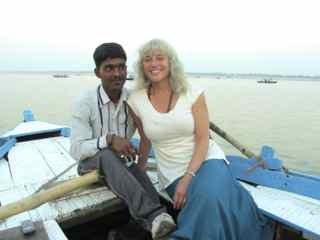
The Ganges is a holy water and holy things happen here too. Raj takes us out in his rowboat so that we can participate in the sunset ceremony at the shore of the (Shiva) Temple. The Arti ceremony offers classical music, elaborate costume and devotional chanting. Boats pack into the shore and people crowd the shoreline to watch and listen.

Paul and I light a candle that is placed in the middle of a garland of flowers. We say a prayer and carefully place the small tray in the flowing Ganges. “What did you pray for”? Paul asks me when we are done. “I prayed for peace in my family”. I answer. “Me too!” he says.

These are the final days of Kumbha Mela, a festival that occurs every 3 years, this year in Allahabad, in Uttar Prudesh. The Naga Babas have come to Varanasi to camp out, smoke chillum, and invite visitors into their small tents to share their beliefs and life style choices. They remain here until Sunday, when the festival of Shivarathri happens. For me, it’s a bit intense. Men’s naked bodies, rubbed completely with ash that is supposed to remind us of the ashes of Lord Shiva. I wonder, “How come it’s okay for these men to be parading around naked, and it’s not okay for a woman to expose even her head?”  I am definitely having problems with the gender issues that are evident here.
Naga Babbas Camping Out

The Naga Baba scene reminds me of my annual Bonnaroo festival in Manchester Tennessee, just without the music. Freaks, drugs and bizarre behaviours are completely acceptable here. I don’t really pick up the spiritual energy. It’s more like a show, and I’m a part of it.

Tall buildings, almost like a solid wall of concrete in various designs and colours comprise the architecture of the old city. They provide a solid backdrop to the sacred Ghats where Hindu people come to bathe and revel in the spirit of the holy waters. As we glide through the river I feel like player piece in a board game. The visual surroundings are a bit surreal, the motion of the paddling creates a dreamlike sensation, and the variety of sounds intensifies the experience. Varanasi… another world, indeed!
Raj our rower
Early morning on the Ganges


Sunday, March 3, 2013

Learning To Let Go


Learning how to be flexible and stretch capacity are significant lessons that practising Yoga provides for me. I notice, as I travel, that these skills are so significant to maintain calm and avoid depending on expectations. Things don’t always turn out the way we think. For instance....

Ø                Our 2:45 train from Jaipur to Jodphur was really at 02:45…not 14:45! So when we arrive at the train station and go straight to platform #3, we wonder why the train isn’t coming. When we finally figure it out, we make arrangements for an overnight bus that leaves at 9:00. We find a nice quiet restaurant with wifi and beer, and, with all our belongings spend a glorious few hours as we wait. Other than the fact that the bus ride took 8 hours instead of the expected 5, we made it to Jodphur happy and satisfied. “Let go of expectations”.

Ø               Our camera was stolen in Bangalore! During the weekend of the Guru Pooja, many people come and go from the farm. On the Sunday afternoon, a special celebration happens where al the villagers from Kaglippura are invited to share a meal. The Gurukala hires cooks who actually begin setting up for the feast the night before. Large fires are lit and delicious Indian food…enough to feed hundreds, is prepared through the night. Disposable plates for all, made from banana leaves reinforces that composting is just a ‘given’.


          Mah reminds me, several times, to be careful. “Villagers”, she says, “are often taking things and don’t even think about the consequences.” I was careful! I really was! Until I wasn’t!

I remember placing my camera on top of my journal on the small cabinet outside the kitchen. I suppose I spent more time in the kitchen than I had anticipated. When I came out, I remember seeing my journal sitting on the cabinet. And I was very conscious of the empty space where my camera used to be! Immediately, I knew! I went right into “letting go” mode. It took some time for me to get over the loss of my camera. Luckily I had downloaded my pictures the night before so all that was on the camera was from that day, but my feelings of the day were altered. Why do people do bad things to each other?

Ø            From Ajmer we missed our train to Jodphur. They said our bus from Pushkar to the train station would only take 25-30 minutes! They said we had lots of time! It took an hour! We arrived, once again, to an empty platform! Bussing it again!

Ø            We flew from Bangalore to Delhi to begin our travels through Rajasthan. We arrive in Delhi and, with all of our bags, we wait at the public stand for our ride to the main train station for our long journey to Jaipur. As the bus arrives we rush on, aware of the havoc that usually occurs as Indian people board a bus. As we settle into our seat on the train, we realize that we are one bag short! We accidently left it at the bus stop! I spent the first part of our train trip in silence. I didn’t want to talk about it. I wanted just to process the loss. The bag, a medium sized carry on cloth bag, contained all the gifts we had bought over the past 3 weeks. Once I listed the actual items, I realized it didn’t amount to many dollars. It wasn’t about the money. It was about the thought and love that went into buying each one. I have to say, it was a very difficult few hours. I wrote my thoughts and feelings in my journal. By the time our train arrives in Jaipur, I had processed the loss enough to let go of the things we left behind.
     
            Once at our hotel in Jaipur, we decided to call the airport in case of the very slim chance that our bag was found and collected. I watched Paul as he spoke to the agent at the Lost and Found in Delhi Airport. I knew the moment he was told, “You’re bag is here.” After some clarifying questions, “What are some of the things in the bag? What kind of bag is it?” they were assured the bag was ours. They gave us a number and a promise that the bag would be there when we passed through Delhi Airport on our way back to Kerala. That story turned out okay and we learned how to better mind our belongings when we travel. And, most of all, the experience gives me practise in letting go and also in noticing the small miracles that abound! Imagine that someone took the time and energy to ensure that our bag can be found.
I suppose that when bad things happen I need to let it go. Better yet, maybe I can make something good come from something bad. Learning happens from life experiences.

Our trip this year has been overwhelmingly fantastic. Every day has presented something new and exciting. Sometimes I am amazed at the experiences we have been lucky enough to have had.  Even the bad things have turned good. Thank you India! Thank you dear Universe!


Friday, March 1, 2013

Peaceful Desert Ride


Last night we slept under a desert sky. Thousands of lively stars sparkled above my reclining body. Laying on my blanket, spread flat on the powdery sand of the Thar Desert, I watched the enormous expanse of sky. The moon peeks out from behind the quiet hills and I watch it move slowly into full view. The moon, the same moon that shows itself everywhere in the world, watched over me, as I watched over her, throughout the night. Exhausted from our camel trek into the desert in Pushkar, I struggled to stay awake, not wanting to miss a moment of the awesome night.

   Christo is the name of the camel that carried me here. On his back, together, we traverse the pathways of the desert, sometimes led by Sahidan, my very own Indian guide. Occasionally, Sahidan hops behind me on Christo’s saddle, preserving his own strength along the way. Paul and a new friend, Cordula, from Germany, also ride. Our very own guide escorts each of us on our own camel. I spend some time getting to know Christo. Camels are such unusual animals! Sometimes his tongue dangles from the side of his mouth in an apathetic, lazy manner. Sometimes his energy gets him moving in a slow run. I do sense he is taking care of me though, gently moving through the sand and, every so often looking back. I think he’s just making sure I’m fine. I am!

The camel trek was a must for us. It offers a nice alternative to sight seeing and a different way to see the place where we are. Pushkar is well known for it’s annual camel fair. In November, thousands of Indians and camels come together in the streets, overflowing into the desert. We’ve never been here for the fair, but I can just imagine how exciting and visually tantalizing it would be!

Pushkar is a very small town in the Ajmer region of Rajasthan. A sign for a roof top restaurant reads “Peaceful Place for Peaceful People”.  I’m ready for that! There are many travellers here who come for relaxation, joining others and fun. Bhang lassies and “special” chocolate can be purchased at any restaurant or local food stand. The restaurants offer a nice blend of Western and Indian foods. We spend a lot of time sitting around tables, people watching, eating good food, and being with friends.
We meet up with Etay and Yael, a couple we met in Kodai Kanal. Travelling from Israel, Pushkar is their last stop before they return home. On the way to Tamil Nadu, in the public bus, Etay got down on his knees and proposed to Yael. Their wedding will happen this summer.

Yael and I even spend some time in Pushkar checking out wedding dresses. What a trip! Pushkar has everything for sale, just like Jaipur, without the intensity. There are beautiful ‘things’ here, and it is way more laid back…. and so cheap! Here, there is a comfortable blend of Westerners and Indians. The city is considered to be one of the sacred pilgrimage sites in India. I get the sense of that as I wander the narrow streets. There is a respect for each other that is evident here. No pushiness happens on the streets, just friendly interaction and genuine interest in each other’s lives.

Rickshaws, cars and large vehicles are supposedly banned from the narrow streets, although, we did experience several vehicles trying to make their way through. People wander and everyone seems to be easy. Our time here offers a beautiful break from the intensity of the last few days.

Stories of divine love and compassion reinforce the energy I experience here. The area is a popular pilgrimage destination for Hindus. History says that Lord Brahma tossed a lotus flower into the air, looking for holy ground. Some of the petals from the lotus settled in Pushkar. They provide the city protection from evil. It is believed that the waters are the result of the tears shed by Shiva after the death of Sati! I think that is a beautiful story of love and life. Sleeping under the desert sky and absorbing the peaceful vibe of Pushkar have provided a perfect space for experiencing that love, and a most beautiful life.
 

Saturday, February 23, 2013

Bussing It Outta Jodphur

We are definitely not in Kansas anymore! Indians in the North are very different from those in the south.
Snake Charmer in Rajisthan

This morning as I sit with my morning chai (quite delicious actually with lots of ginger) I notice that the people around are morose and serious. My own smile, previously a means of communicating, is ineffective here. Maybe the desert influence affects the moods of the population. My struggle to defer judgement and forgo opinions reappears. This is Rajasthan, the epitome of intensity and heat and I won’t be here long enough to even begin to understand. Hindi and Rajasthani are the two languages spoken here. Unlike Kerala, Tamil Nadu and Karnataka in Southern India, not many people speak English. All perception then, relies on the visual. And we definitely look different from each other! I can’t even begin to imagine what others are thinking about us. And yet, when it comes right down to basics, we are really all the same.

We board our (7:30 am) bus in Jodphur to Pushkar after a few surprises. First, after paying a rickshaw to deliver us to the bus stop, we discover that the bus is being prevented from entering the town and we have to take another rickshaw to get there. We watch all the people with their families and their belongings pack into rickshaws eagerly. We are told it will cost another 80 rupees. “No way” I say. “We’ve already paid to get here.” I am convinced that the other people are not putting up any more money. The travel company should be paying for this mishap! My negotiation pays off and we are given the same treatment as others. I feel a bit triumphant! I am no longer the ‘fresh monkey’ I used to be during my first visit to India.

Finally we get on our bus and settle in. We wait without the engine starting for what seems like a long time. I decide to take advantage of the wait and find a toilet. My search for one is unsuccessful. It’s okay, I figure. My many years of teaching and my numerous bus rides in India and South America have conditioned my bladder well. I can wait. “Let’s just leave already!” It is now 10:40.

Waiting Place
The bus never leaves. Instead we hear shouting in Hindi from the front of the bus. In response, everyone around us gets up and, gathering all their belongings, they begin to get off the bus. We wait until the end. We are travelling heavy and we’re not sure what’s happening. Finally we follow the crowd. Outside we are left on the side of a road, in, what seems like, the middle of nowhere. All of us… waiting. We discover that the bus we were on has been ‘seized’ by police because of failed inspection and lack of appropriate papers. We are instructed to wait (about 20 minutes) for the next bus.

Though there are not many places around, I decide to find a toilet. I leave the group in search of some place where I can go. I return within minutes. No luck! Now I’m getting nervous. If the bus does come soon, I will be stuck without access to toilet…and I already have to go badly. Paul offers to help. Maybe he can hold up a towel, but I’m reluctant. There is no place to hide in India!

Finally I make eye contact with a Rajasthani woman who is holding one child with two others at her side. Our simultaneous smile to one another confirms for me that I have found a comrade. I approach her slowly. “Toilet” I ask quietly. She responds in Hindi. Of course, I don’t understand. She puts the child from her arms on the ground and leans over to grab my hand. Together we walk to the side of the building. There is a broken down wall surrounding a small square of land. Garbage is piled in various corners and scattered all over. The smell of rotting discarded waste is overwhelming. I know I have no choice, and, as my new friend stands guard, I squat right there to pee. I feel so relieved and so grateful for her help. Women… anywhere and everywhere… so much the same… same and different.

The 'Ladies' Room
Finally our new bus comes and we board. It’s comfortable with plenty of space in our sleeper cabin. Within 200 metres, however, our bus stops again. We’ve been pulled over by Rajasthani police. Everyone on the bus seems to be calm. I am definitely feeling okay. It’s a Rajasthani experience, no doubt. As we wait and watch the commotion outside our window, between the bus driver and the officers, I wonder what will be. I think this is normal. No one seems to flinch. Paul is starting to lose it. So is the baby sitting in the front of the bus.

There are no explanations. No apologies. No one tries to communicate with the passengers.

Finally the driver returns. I can’t read his face. It is only the sound of the ignition turning and the shift into gear that affirms that we are, once again, on our way…for now. It is 12:14!
New Friends!

Friday, February 22, 2013

Jaipur


Jaipur is different from other parts of India. It is more intense…less spiritual and more material. The feeling here is a response to my senses. The colours of the buildings and the products being sold all over the city startle my perceptions. Sounds on the street blend with the visual stimulus and complete the experience. It is the Jaipur of the pictures I have seen in my life on posters and in books. It is, in fact, like a movie that I have become a part of.

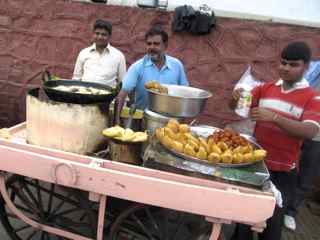
Walking on the elevated sidewalk, I am careful to avoid stepping in the human feces that cluster in piles along the path. Smells of urine along the way, remind that men live not far away, perhaps lying directly in my path. As the city awakens, outside grills begin to burn, preparing samosas and chicken tikka kabobs for fast food satisfaction. Deep fried sweet treats, warm from the deep vats filled with oil, emit a tempting aroma.

The temples and forts and palaces dominating specific areas are also not exempt from the consumer bug. I make regular attempt to veer away from the shops and the merchants as I walk through the buildings. The Amber Fort, spectacular in its design, and its energy, completely inspires my imagination. The courtyards open to gates that lead to private palaces of the kings and several pavilions and halls offer me a chance to pretend. I imagine the Raj community living here five thousand years before. The Kama Sutra, the first publication of sexuality began here! 

I love to find myself immersed in those daydreams. So, no wonder, I get disturbed when a young man approaches me with  “Ganesh made from rosewood?” he says. “How much?” I ask (stupid me!) “1200 rupees”. “1200 rupees!” I shout. “That’s crazy! I just bought one for my son!” “How much then” he asks following me right out the door. “I’m not interested” I say annoyed. “800 rupees” he retorts. By the end of the interaction, he had reduced the Ginesh to 200 rupees. That’s ridiculous! Don’t think it didn’t cross my mind to go back and grab it! But I didn’t want to feed that behaviour.

  Jaipur is a city of consumerism and we completely got sucked into it. Here one can buy precious and semi-precious gems for near to nothing. Silk carpets created by human hands are intricately woven by villagers who have lived with the process so long that they don’t even need to refer to a template. They understand how to design and produce incredibly ornate carpets from memory.

Today Paul and I visited a carpet shop. We met the weavers who are descendants of carpet weavers. Each strand of silk or camel hair is intricately woven in to the design. With a machete like knife, every strand of wool is carefully cut. The designs are absolutely fantastic. The work is completely unique and magical. I’ve never thought of a carpet as an emotional object! Watching the energy with which the weavers work, made me realize the commitment and sweat that is shared through the art.

I think about all the ‘things’ available to buy. If you don’t find what you’re looking for in one stall, it will definitely show up just down the road. And simply walking down that road can be a challenge! With such a high concentration of people, and incredible pollution, breathing can become difficult. Rickshaw drivers, tour guides, merchants, anybody with something to sell make walking through the streets almost unbearable for me.

“See my shop, ma’am.” Calls a dark-skinned older man, as he hurries to walk beside me. “Cheap, cheap. Good prices. No buy. Just come and look.” “No thank you.” I reply.
“Please just to look. Come drink chai. No buy. Just look.”
“No, thank you”, I say just a bit more emphatically, this time with my hands clasped at my heart in the form of ‘namaste.’

“Just one minute!” he perseveres.
At this point I turn around to face him. I clasp my hands at my heart. “Sir” I say firmly, “No thank you. Namaste. Have nice day.”
I’m learning how to get along here. It has taken some time, and, quite frankly, I wouldn’t want to live here and be doing this all the time, but I am figuring it out. There is a firmness that’s necessary; a respectful assertiveness that acknowledges my own needs as well as theirs.
In the pink city of Jaipur, life is all about money. For many, seeing a western couple walking down the street, signals dollar signs. My challenge is maintaining a sincere respect for people who view others as anything but human. And I also know that talking to one another is a powerful way to work through these misconceptions. People who I talk to on the street become interested in who I am, and know, too, that I’m interested in them. We become more like each other, because in the end, we find the similarities that connect us. “Do you have children? What do you do in your country? What do you think of India? Tell me about your family” are all topics that arise instantly and easily on the street. India is teaching me to take the time to listen and also to not be afraid to share ‘my story’ as well.

By the way, we are not leaving Jaipur unaffected! We bought an enormous amount of those ‘things’ while here. Carpets, bedding, precious stones and many treasures to share with friends and family back home. We even needed to buy another bag to carry it all!